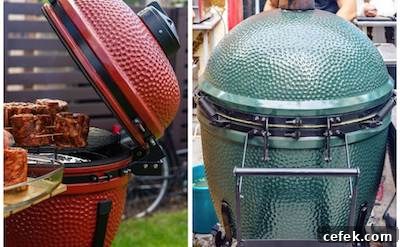
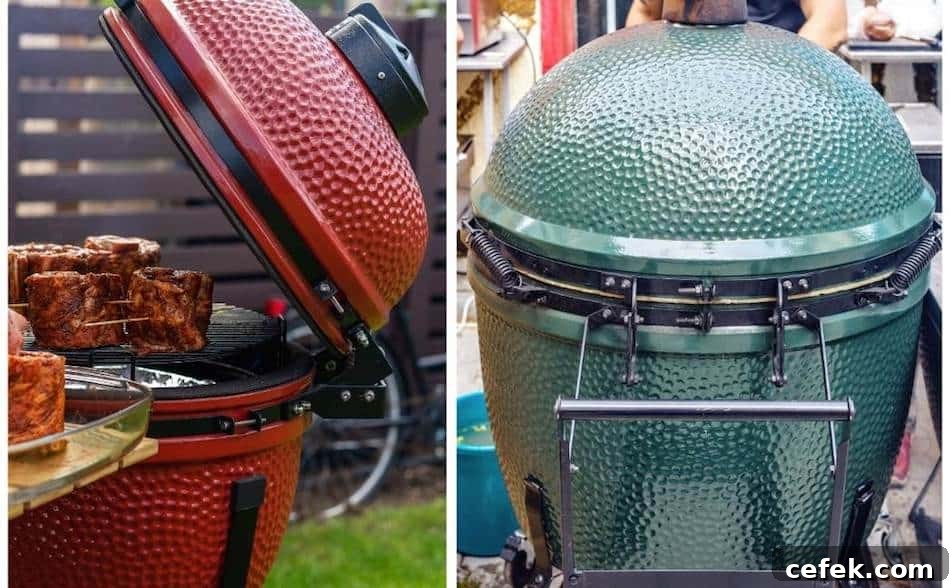
If you enjoy grilling, you’ve likely asked which ceramic cooker is better: the Big Green Egg or the Kamado Joe. Both deliver excellent results, but they differ in design, components, and features. Below I summarize the most important distinctions and practical differences so you can decide which model best fits your needs.
Summary: The Kamado Joe is often viewed as the more advanced option thanks to its higher-quality components and constant innovation. While the Big Green Egg has a strong legacy as the original ceramic cooker, Kamado Joe’s ongoing improvements—especially on hinges, cooking systems, and convenience features—have made it a popular choice among serious grillers.
Key Points
- Both Big Green Egg and Kamado Joe are reputable ceramic grills capable of excellent grilling, smoking, roasting, and baking.
- Kamado Joe typically includes more accessories and modern features; Big Green Egg is often sold with fewer included extras and relies on optional add-ons.
- Performance for cooking and flavor is similar between the two, but Kamado Joe leads in convenience, engineering, and some design choices.
- Price comparisons depend on model, size, and accessories; a fully equipped Egg can cost about the same as an all-included Kamado Joe.
- Both cookers retain heat well, reach very high temperatures for searing, and are fuel efficient with lump charcoal.
17 Major Differences
There are multiple models of Kamado Joe (Classic 2, Classic 3, Big Joe, etc.). I compare those models with various Big Green Egg sizes and note where newer BGE updates have improved things.
| Difference | Big Green Egg | Kamado Joe |
|---|---|---|
| Grill | Standard single-level grate | Divide & Conquer flexible multi-level system |
| Accessories | Sold separately à la carte | Many accessories included with unit |
| Price | Base price lower; costs rise when adding accessories | Classic 3 higher but includes more components |
| Lid | Older models: spring hinge; newer models: improved hinge | Air-lift hinge that offsets most of the lid weight |
| Ash Disposal | Requires ash tool and scraping | Pull-out ash drawer for easy cleaning |
| Chimney | Older cap design less stable; newer revised design | Robust, well-designed chimney |
| Stand | Assembled stand, less rigid | Welded, wider, and more stable base |
| Handle and Side Table | Wood handle and wooden side benches | Durable molded handles; Classic 3 adds retractable metal table |
| Lid Seal | Felt-style gasket | Oven-grade wire mesh gasket |
| Lid Alignment | Can be slightly off | Tighter alignment |
| Lid Lock | No factory latch | Reinforced latch option on many models |
| Wheels | Larger wheels; plastic locks on some models | Smaller wheels with metal locks |
| Firebox | One-piece ceramic fire ring/box | Multi-panel firebox; stainless outer ring on fire ring |
| Thermometer | Smaller hood-mounted gauge | Larger, easier-to-read thermometer |
| Setup | Longer assembly time | Quicker out-of-box setup |
| Packaging | Standard cardboard and foam | Heavier-duty packaging with wood reinforcement |
| Availability | Sold through select dealers | Widely available through multiple retailers |
Grill Capacity – Big Green Egg vs Kamado Joe
| Model | Grid Diameter | Whole Chickens | Rib Racks | Burgers |
| Big Green EGG 2XL | 29″ / 73.66 cm | 14–16 | 20 | 35–40 |
| Kamado Joe Big Joe III | 24″ / 60.96 cm | 11 | 12 | 24 |
| Big Green EGG XL | 24″ / 60.96 cm | 11 | 12 | 24 |
| Kamado Joe Big Joe II | 24″ / 60.96 cm | 11 | 12 | 24 |
| Big Green EGG Large | 18 1/4″ / 46.99 cm | 6 | 7 | 12 |
| Kamado Joe Classic III | 18 1/4″ / 46.99 cm | 6 | 7 | 12 |
| Kamado Joe Classic II | 18″ / 45.72 cm | 5 | 6 | 11 |
| Kamado Joe (Joe Jr) | 13.5″ / 34.29 cm | 1 | 1 | 4 |
| Big Green EGG Medium | 15″ / 38 cm | 3 | 4 | 6 |
| Big Green EGG Small / MiniMax | 13″ / 33 cm | 1 | 1 | 4 |
| Big Green EGG Mini | 10″ / 25.4 cm | 2 breasts | – | 3 |
Main Differences Explained
- Grill surface: Kamado Joe’s Divide & Conquer system offers flexible multi-level cooking and heat zones; the Egg uses a traditional single grate unless you add accessories.
- Accessories: Kamado Joe typically includes a stand, side tables, heat deflectors, and more. Big Green Egg ships with the egg, grid, and thermometer; other items are add-ons.
- Price: A base Big Green Egg is cheaper, but after adding equivalent accessories the total cost between similarly equipped units is comparable.
- Lid and hinge: Kamado Joe’s air-lift hinge makes opening and adjusting the lid effortless. Big Green Egg upgraded its hinge on newer models, narrowing the gap.
- Ash management: Kamado Joe’s pull-out ash drawer is more convenient; BGE requires manual ash removal with a tool.
- Chimney and cap: Joe’s chimney has a long track record for stability and durability; BGE updated its design to address past issues.
- Build and stand: Kamado Joe often includes a more robust welded stand and integrated features; BGE’s modular options are flexible but sometimes less rigid out of the box.
- Gasket and alignment: Kamado Joe uses an oven-grade wire mesh seal and tighter lid alignment; BGE uses a felt-style gasket and can require fine adjustments.
- Readability and controls: Joe’s larger hood thermometer and included features make monitoring easier; Egg users often add aftermarket thermometers or probes.
- Packaging and delivery: Kamado Joe tends to ship in heavier, reinforced packaging; Big Green Egg uses standard protective materials.
- Availability: Kamado Joe is widely available at major retailers; Big Green Egg is sold through select dealers and specialty stores.
What Comes With Each Unit?
Big Green Egg’s base package includes the ceramic egg, a cooking grid, firebox, and a built-in thermometer. If you want a nest (stand), side tables, plate setter (convEGGtor), pizza stone, or covers, these are sold separately so you can build a custom setup.
The Kamado Joe typically arrives with a cart or stand, side tables, a pizza stone, the Divide & Conquer cooking system, heat deflectors, cooking rack, charcoal basket, and on Classic 3 models the Slow Roller Smoke Generator.

Cleaning and Maintenance
Kamado Joe’s slide-out ash drawer simplifies cleaning and reduces time between cooks. Big Green Egg’s ash removal is manual and requires scraping. Both grills are low-maintenance overall—regular ash clearing and occasional gasket checks keep either unit performing well.
Performance and Food Quality
Both cookers produce excellent results. In side-by-side taste tests, properly-operated grills produce negligible flavor differences. The main distinctions are convenience, flexibility, and build—Kamado Joe focuses on user-friendly innovations while Big Green Egg offers a proven, established platform and a broad ecosystem of accessories.
Fuel and Temperatures
Lump charcoal is the recommended fuel for kamado-style grills because it burns hotter and cleaner than briquettes. Both brands can reach very high temperatures (750°F+), making them suitable for high-heat searing and pizza, as well as low-and-slow smoking.
Which Should You Choose?
If you want the latest convenience features, included accessories, multi-level cooking, and easier cleanup, Kamado Joe is an attractive choice. If you prefer the long-standing reputation, a customizable build-your-own approach, and the traditional Egg experience, Big Green Egg remains a very capable option. Either grill will deliver great results; the best pick depends on which features and buying model suit your priorities.
Final Thoughts
Kamado Joe has pushed innovation in the kamado category with features like the Divide & Conquer system, improved hinge, ash drawer, and, on the Classic 3, the SlōRoller smoke generator. Big Green Egg remains a reliable, iconic cooker with a large accessory market and loyal following. Evaluate how you plan to use the grill, whether included accessories matter to you, and how much assembly and maintenance you want to handle—those factors will guide the right choice for your backyard cooking.
Articles On Smokers
Which Traeger Should I Buy? The Complete Guide To Traeger Pellet Grills
Kamado Joe vs Big Green Egg- The 17 Major Differences
Can You Smoke on a Weber Kettle?
The Different Types of Meat Smokers: An Extensive Guide
The Best Smokers For Beginners: A Detailed Guide With Pricing
Which Weber Smokey Mountain Should I Buy? The Complete WSM Buying Guide
The Best Charcoal Smokers: An In-Depth Guide
Ceramic Egg Smokers – Are They Worth The Money?
Are Electric Smokers Good? The Pros & Cons (Plus 6 Models)
Are Gas Smokers Any Good?
Are Primo Grills Any Good? We Compare The Oval Kamado To Other Ceramic Grills
What is an Offset Smoker? A Guide to Stickburners (Plus 7 Affordable Models)