I was at dinner the other night, talking about food, when Janette mentioned that her husband had been trying to make aioli sauce. His first attempt in a blender ended in frustration, but after watching an episode of Anthony Bourdain’s ‘No Reservations’ in Provence he learned the traditional method uses a mortar and pestle. In the show, while the old French woman made the aioli, Anthony observed, “It’s very gentle, the process…You gotta be careful. You have to keep your voice down. Show a little respect for the process…” Janette said that inspired, he sat down quietly and produced an amazing aioli. Her description made me want to try it myself.
Aioli sauce and bread
Aioli (pronounced eye-oh-lee) resembles garlic mayonnaise but is distinct, largely because of how it is made. Mayonnaise can use a variety of oils, while traditional aioli is made exclusively with olive oil. You could stir crushed garlic into mayonnaise, but preparing aioli by hand with a mortar and pestle is a rewarding process that produces a pungent, delicious sauce. On a scale of 1 to 10, its flavor registers as an 11 — well worth the effort.
Often called “the butter of Provence,” aioli reflects the region’s landscape, where olive trees, goats and sheep thrive more than cattle. The sauce is strongly associated with Provence but likely traces back to the Roman aleatum, a garlic-and-olive-oil preparation. In Catalonia the similar sauce is known as allioli and is traditionally made without egg.
Making aioli
Aioli Ingredients
Ingredients
- 3 medium cloves of garlic, sliced
- 1/2 tsp coarse salt (kosher or sea salt)
- 1 egg yolk
- 1 1/2 tsp lemon juice
- 1/2 cup (118 ml) extra virgin olive oil
- Freshly ground black pepper
Method
Prepare all ingredients and choose a quiet place to work. Put the salt and garlic into the mortar and, using the pestle, crush them into a smooth, creamy paste.
Garlic and coarse salt
Add the egg yolk and lemon juice, mixing until combined.
Egg yolk and garlic paste
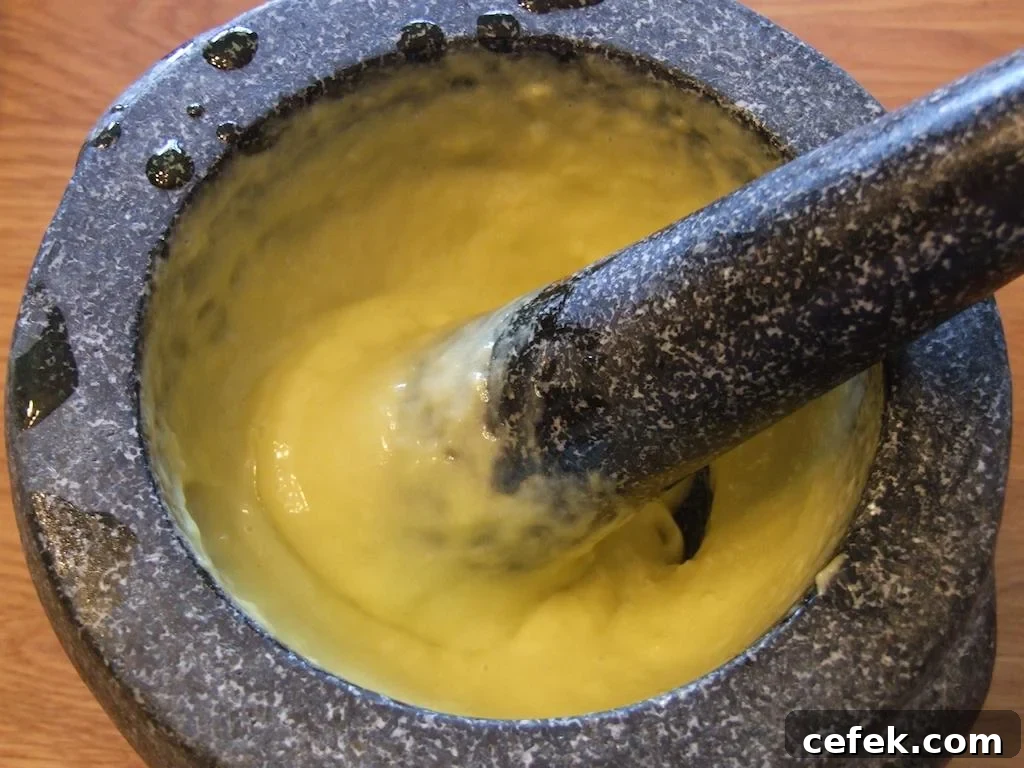
With one hand, rotate the pestle smoothly around the mortar in continuous circles. With the other hand, add the olive oil one drop at a time, only adding the next drop once the previous one has been fully incorporated. Continue this slow addition until the mixture begins to thicken and an emulsion forms; then you can add slightly larger amounts of oil. Take your time — rushing can cause the emulsion to break and the oil to separate. The process should take about 10 minutes. When all the oil is incorporated, season with freshly ground black pepper.
Stored in the refrigerator, aioli can keep for up to two weeks — if you can resist eating it all at once. Besides spreading it on bread like butter, it makes an excellent vegetable dip and pairs beautifully with fish or chicken. In Provence, aioli often stars in Le Grand Aïoli, a communal dish of boiled fish (commonly cod), boiled eggs, and seasonal vegetables such as green beans, potatoes and carrots, all served with the sauce at the center of the table.
Le Grand Aioli