Timing matters most when using a microwave. Cooking times that work in one oven won’t always translate to another because microwaves vary by wattage, size and design. Below is a clear, user-friendly guide to converting recipes written for a 700-watt microwave so they will work in a 1450-watt oven. Use this as a starting point and adjust slightly for your appliance, food quantity and container type.
Microwave cooking relies on time rather than sight for best results. Foods heat quickly and unevenly in a microwave, so following a wattage-appropriate time helps avoid undercooking or overcooking. A higher wattage oven like a 1450-watt model will cook faster and more intensely than a 700-watt oven, so you can’t simply use the same minutes and seconds. This conversion helps you adapt recipes safely and effectively.
How to use the conversion guide:
- Find the time listed for 700 watts that matches your recipe.
- Use the converted time for 1450 watts as a starting point.
- Check food halfway through and at the end of the suggested time. Stir, rotate or rearrange if needed to promote even heating.
- If food isn’t done, add short increments (10–30 seconds) until it reaches the desired temperature or doneness.
- Remember that dense or layered foods and cold or frozen items often require longer or additional intervals compared with small, single-serving items.
700-watt to 1450-watt Conversion — Practical Guidance
Because a 1450-watt microwave delivers more than double the power of a 700-watt model, cooking times are significantly shorter. A reliable method for conversion is to divide the original time by the ratio of the wattages, then round down slightly and test. For example, a dish that takes 2 minutes (120 seconds) at 700 watts would theoretically take about 58 seconds at 1450 watts (120 × 700 / 1450 ≈ 58). In practice, start a few seconds shorter than the calculated time and add brief intervals as needed.
The following table illustrates typical conversions and common applications. Treat these as starting points; actual results will vary based on the food’s volume, temperature before cooking, container size and the microwave’s internal layout.
- Small single servings (vegetables, leftovers): reduce original 700-watt time by about 50–60% for 1450 watts.
- Frozen entrees and larger portions: reduce time by approximately 45–55%, then check and add time in short increments.
- Reheating liquids: reduce time by 50–60%, stir halfway and watch carefully to avoid boiling over or superheating.
- Defrosting: use the microwave’s defrost setting when available; if manually converting, increase interval frequency and reduce power rather than applying full 1450-watt power for the entire converted time.
Practical examples (approximate starting points):
- 700-watt: 1 minute → 1450-watt: 25–35 seconds
- 700-watt: 2 minutes → 1450-watt: 55–70 seconds
- 700-watt: 3 minutes → 1450-watt: 1 minute 20–1 minute 40 seconds
- 700-watt: 5 minutes → 1450-watt: 2 minutes 10–2 minutes 30 seconds
These examples reflect common adjustments, but always monitor the food and adjust for your specific microwave and recipe. Thinner containers, glass dishes and ceramic plates may heat differently than plastic. When in doubt, reduce the converted time and check early — you can always add more time, but once food is overcooked it can’t be undone.
Safety tips and best practices:
- Use microwave-safe containers and covers to trap steam and promote even heating.
- Stir and rotate foods during cooking when possible to reduce hot spots.
- Allow standing time after cooking; residual heat continues to cook food for a short period.
- Check internal temperature for meats and dishes that must reach a specific safe temperature.
Conversion Chart Image
The image below provides a visual reference for converting a wide range of common microwave times from 700 to 1450 watts. Use it alongside the practical tips above to fine-tune your cooking approach.
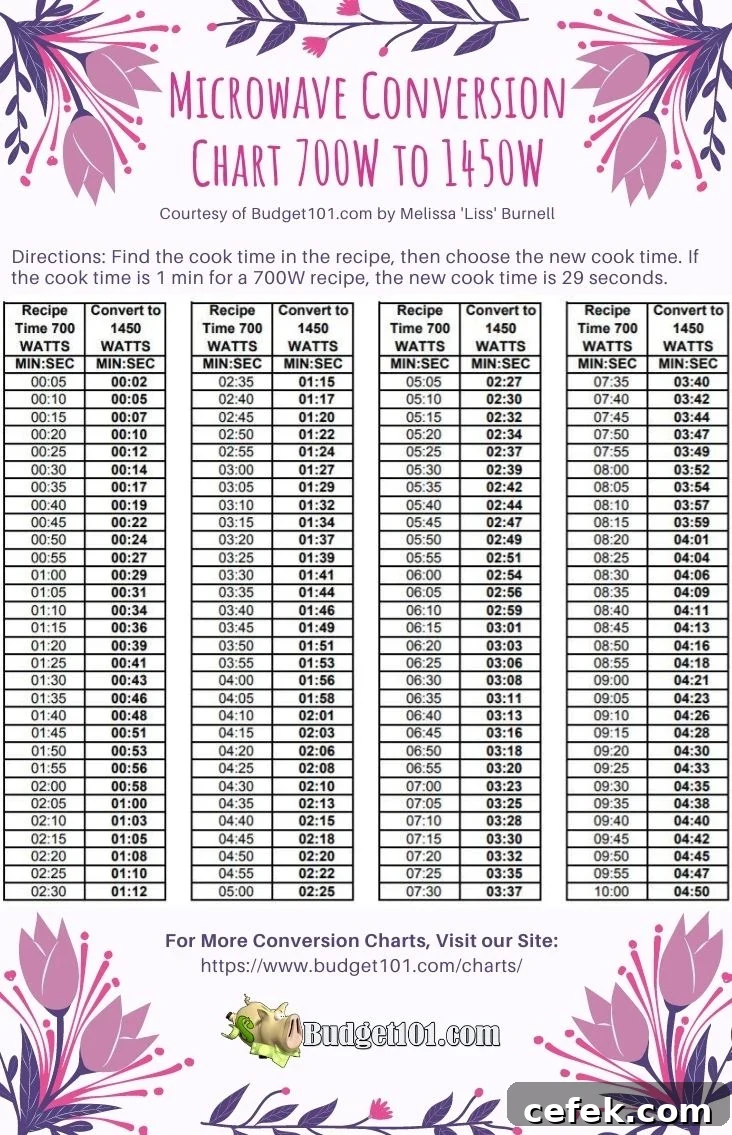
Keep in mind that the chart provides starting points rather than exact times. Small adjustments will make a big difference in final texture and temperature. With a few tests and observations, you’ll quickly learn the best converted times for your favorite recipes and your specific 1450-watt microwave.